WE HAVE MOVED!

If you would like to continue getting great fitness information, please visit our website to see the new blog. You can also sign up for the newsletter to be reminded when our new blog posts come out!

Thursday, May 17, 2012

Be Wary of Your Water


I was all set to write an article about how drinking water is important and that we all need to get enough for all kinds of health related reasons, but then I found the article that will follow. 

I am certified through an organization call Precision Nutrition and through my certification I have access to a huge database of forums, articles, and research. In looking for some interesting ideas to include in my piece, I came across one article that I feel touches on an important, but often under-appreciated topic concerning water: the negative consequences of drinking bottled water.


There is not much I can add to the topic, so please, read below and start re-thinking your use of water, bottled water, and plastic bottles in general.


__

All About Drinking Water

by Ryan Andrews, 2009
What costs more in North America: gasoline or water?
Surprise! Bottled water is ~$9 per gallon and current gasoline prices are under $2.
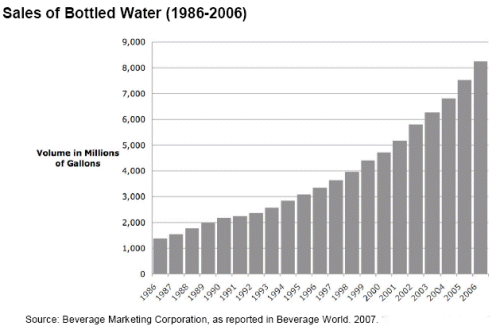
Hydration is the third largest global industry, behind oil and electricity. Americans spend almost $8 billion per year on bottled water.
To put this in perspective, that’s the same amount of money that the U.S. spent on economic aid in 2003. The U.N. estimates that it would require $30 billion each year to provide safe, clean, drinking water to the entire planet. Our world spent 3 times that amount on bottled water in 2007.
bottled water usa231107 All About Drinking Water

What you should know

The Safe Drinking Water Act (SDWA) is the federal law in the U.S. that gives the Environmental Protection Agency (EPA) responsibility for setting national drinking water standards for the 250 million people who get their water from public water systems. Since the SDWA was passed in 1974, the EPA has set standards for more than 80 contaminants that may occur in drinking water and pose a risk to human health.
But do the standards protect the public or accommodate the industry?
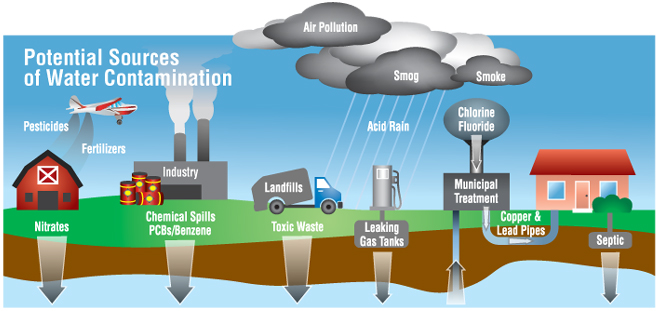
Water will frequently contain some impurities, since minerals and containments are absorbed from surrounding structures. Some are minor contaminants, the ones that make water a bit dirty, discolored, or smelly. Then there are contaminants that cause things like cholera, hepatitis, and death.
The more serious contaminants to drinking water include:
  • Improperly disposed of chemicals
  • Human and animal wastes
  • Pesticides
  • Micro-organisms such as giardia
  • Naturally-occurring substances (such as arsenic)
Drinking water that is not properly treated or disinfected, or which travels through an improperly maintained distribution system, may also pose a health risk. The EPA reported that drinking water utilities will need an estimated $277 billion in upgrades before the year 2022.
potential sources of water contamination All About Drinking Water
jug o atrazine 228x300 All About Drinking Water
Possibly coming soon to a water bottle near you
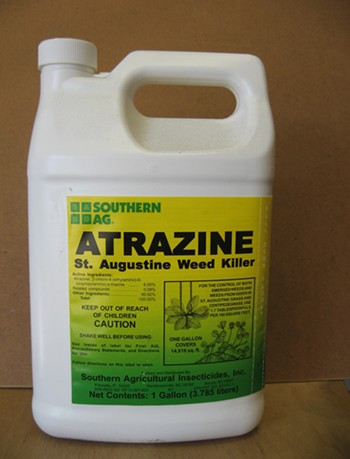
Some of the more serious contaminants include lead, atrazine, arsenic and pharmaceuticals.
Lead
Lead contamination of drinking water is expensive and difficult to control since it generally enters the water supply via the corrosion of materials containing it. Since lead rarely occurs naturally in source water, it’s not treated at the facilities.
Atrazine
Atrazine is the top contaminant found in drinking water, ground water, and surface water. It’s an agribusiness chemical (think: herbicide) that is banned in the European Union.
It seems to act as an endocrine disruptor and is associated with cancer of the prostate, breast and ovary. It has been shown to “de-masculinize” male amphibians. National Geographic even claims that a low sperm count can be blamed on pesticides in U.S. drinking water.

atrazine use across the us All About Drinking Water
Use of atrazine across the United States
Arsenic
Although food is the most significant source of arsenic, drinking water is the other main source. Arsenic is commonly found in industrial processing and mining runoff, but also occurs naturally.
Long-term exposure to arsenic is related to increased risk of cancers as well as skin lesions such as hyperkeratosis and pigmentation changes.
Pharmaceuticals
Pharmaceuticals used for humans and animals are also starting to be found in drinking water. Furthermore, traces of household cleaning products, fragrances, cosmetics and by-products of the artificial sweetener sucralose (Splenda) are turning up. Heck, even Prozac has been discovered in the fish that swim in waters around Texas.
jack and jill well water All About Drinking Water

A widespread problem

When 25 of the largest American cities were examined, only three had no water-quality violations. Water from all cities contained significant quantities of contaminants, including lead, chlorine and the bacteria E. coli, one of the most common causes of intestinal poisoning.
While the U.S. doesn’t keep records of who gets sick from tap water, experts have estimated that between 500,000 and 7 million people get sick from tap water each year. Because water also washes our food, our bodies, and our clothes, we probably eat and touch a lot more contaminants than that.

How does water typically get to your house?

The Walkerton tragedy
In May 2000, the small town of Walkerton, Ontario suffered a tragedy: seven people died and hundreds more became seriously ill after drinking water contaminated by E.coli. An inquiry revealed that the system broke down after both the water manager and the provincial government neglected their responsibilities.
More
If you live in a large city, water likely gets to your house from surface water sources like lakes, rivers, and reservoirs. In rural areas, water is likely to be pumped from a well. If you live in “Backcountry Smallville” then your drinking water might be a little bit dirtier than if you live in a major city, mainly due to funding for water treatment and consumer demand.
When considering the safety of your water, think about the activities that occur around the water supply.
Is there a manure lagoon? A pulp and paper mill? Might want to look into that.
Are there endless fields of plants and trees? That’s probably a good thing.
Also consider the pipes that the water was delivered in, which, depending on the type, might contribute to higher levels of asbestos, toxic metals and other pollutants. Even your faucet can leave by-products in water, as older faucets sometimes containin brass alloy and lead. Probably not a good thing.

Water treatment

Why don’t we all just gather water from those pretty streams and lakes in the countryside? They look so pure and harmless. Well, remember that you wouldn’t be the only drinker. Insects and other animals drink the water, lay eggs in it, and can leave behind their waste.
Indeed, less than 3% of the worlds water is fresh and only one-third of that is drinkable — in other words, although the Earth is mostly covered with water we can only drink the barest 1% of it. (Read that sentence again before you leave the water on while shaving.)
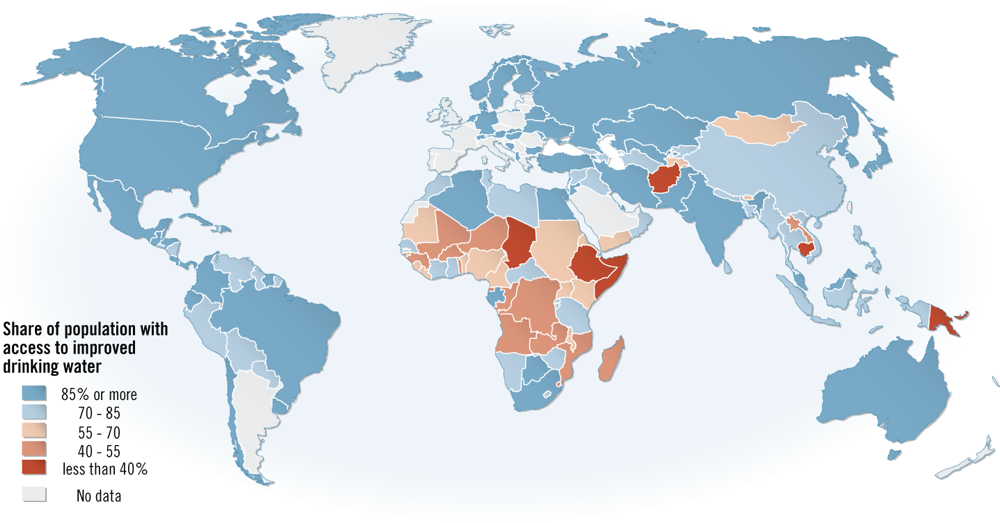
access to drinking water globally All About Drinking Water
Access to safe water worldwide
We need to treat our water before we drink it. When water goes from its natural source to the treatment facility, contaminants are removed and chemicals are added.
Chlorine
Nearly every water treatment facility uses chlorine as a disinfectant. Chlorine can create harmful compounds when it combines with certain organic chemicals, which may cause some health concerns.
Fluoride
Fluoride has been added to water since 1945. While many countries use fluoride in water (like the U.S. and Canada), many countries don’t (like Austria, Germany, and Japan).
Fluoride has the same toxicity as lead and arsenic; thus, not all major health groups support fluoridating water.
Before protesting outside the local water treatment facility, it’s important to realize that water treatment means that most industrialized countries have very safe water.
Each year in developing countries nearly 2.2 million people (equivalent to the population of Houston, TX), most of them children, die from diseases associated with lack of safe drinking water and inadequate sanitation. That’s almost 5,500 people each day — just because they don’t have clean water.
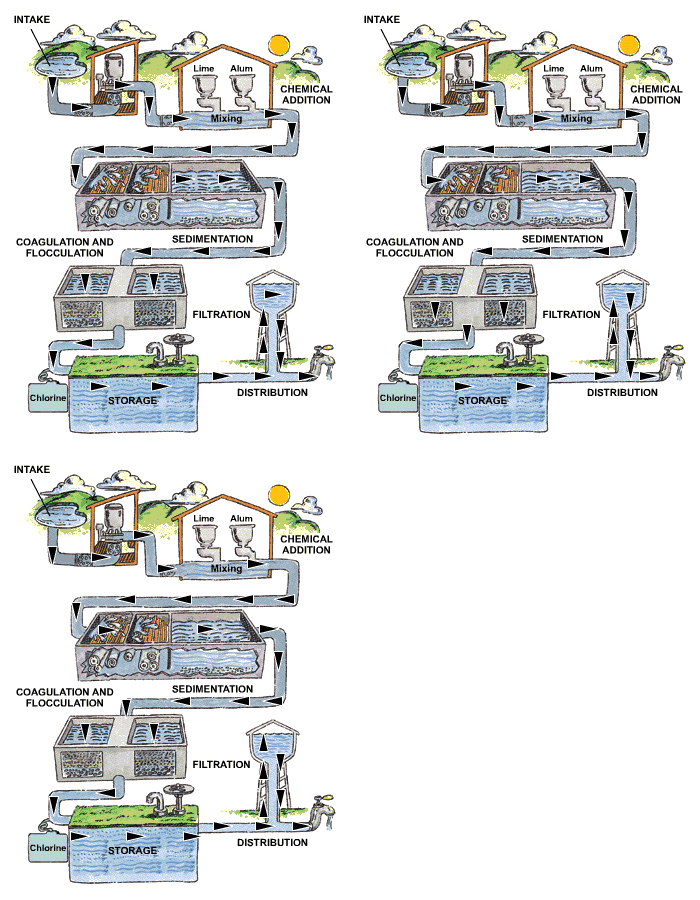
water treatment All About Drinking Water
The water treatment process

Water supply

While we don’t have much water to use, we act as though it’s an infinite resource.
80% of residential water in the U.S. goes to landscaping. 2/3 of the world will face water shortages by 2025.
Not counting food production, each person in the U.S. and Canada uses about 150 gallons of water per day. Each person in the U.K. uses about 30-40 gallons of water per day. Each person in the developing world uses about 13 gallons of water per day.
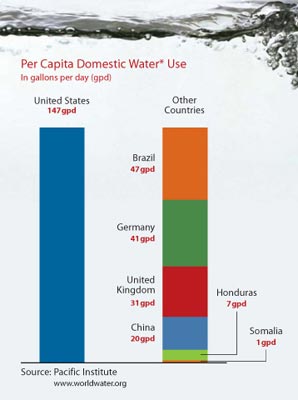
current wateruse chart All About Drinking Water
Per capita domestic water use, in gallons per day
What about desalination? Can’t we just use all of the abundant salt water, get rid of the salt, and drink it? Well, desalination removes ions that are essential for plant growth. That means the water isn’t very useful for agriculture. But it still looks to be a workable option for the future.

Other water filters

There are many ways to clean water. The four basic water purifiers include filters, reverse osmosis, distillers and ultraviolet units.
Charcoal filters absorb and modify pollutants. Reverse osmosis depends on water pressure and doesn’t accumulate pollutants over time (like a charcoal filter). Distillers use a lot of electrical power, as the water is boiled to create water vapour, which can help to kill microorganisms. All of these filters may actually introduce new pollutants while removing others.
A guide to water filters can be found here.
Bottled water doesn’t appear to be any better, safer, or purer than tap water. In fact, according to the Food and Drug Administration in the U.S., less than one person is regulating the entire bottled water industry.

Further resources

Summary and recommendations

Request a report that shows the quality of your local water. It’s usually free, but it might not cover all of the potential toxic chemicals. Inquire about polyelectrolyte flocculants. If those are added during water treatment, it should warrant further investigation.
Consider buying a home test kit or use a lab to test your water. Make sure it’s not bogus – do some research. See here for more on water testing.
If your water is clean, then using tap water is likely your best option. If your water requires some cleaning, then investigate a water purification option – see here for more.
Challenge your daily water use. Consider the following ideas to shrink your water footprint.
Drink tap water
Filtering it at home is likely the best option. Bottled water costs 1,000 times more than tap water. 1 litre of bottled water takes 3 litres of water to produce.
Leave it to nature
Watering our lawns sucks up major water. Buying a rain sensor and letting nature do its job can be helpful.
Consider xeriscaping, or planting native species that don’t require additional watering. You can save 75% of the water you’d typically use for watering your lawn and garden.
Measure correctly
About 1/3 of our country’s drinking water is used to brew coffee, and a lot of that goes to waste when we pour out what’s left in the pot. If every household measured more accurately and saved just a cup of water each time, America would conserve about 7 million gallons of water a day. We would also save the 259 million gallons that would have been used to grow the wasted coffee beans.
Wash smart
Buy a front-loading washing machine, which uses 40 to 60 percent less water than traditional top loading machines.
Don’t pre-rinse dishes for the dishwasher, and run it only when it’s full.
This can save you 7,300 gallons of water a year. That’s as much water a person drinks in their lifetime.
Go plant style
The average North American diet takes nearly twice as much water to produce as a plant-based diet. It takes about 17 times as much water to produce beef as vegetables. Swap out one serving of meat a week and you can save more than 450 gallons of water.
Drive through
A commercial car wash uses nearly 100 gallons less per wash than hand washing. The facilities often recycle the water they use too.
Take up space
Put a brick in your toilet tank to reduce the amount of water used per flush by around one gallon.
Eat PN style
Buy more whole foods such as vegetables, beans, fruit, rice, and potatoes. Processed foods and drinks (chips, premade meals, soft drinks) take a lot more water to produce than those that come from the farm.

Other interesting information about water

How many cups of water does it take to make a cup of coffee? If you answered one, you’re way off the mark. When you factor in the water used to grow the beans, the answer is more like 590.
Drinking pop is a drain on water reserves. Producing 1 litre of pop requires approximately 2.5 litres of water.
Water is the only substance found on earth in three forms solid, liquid, and gas.
Over 47 million barrels of oil per year are used to produce plastic bottles (many of which are for bottled water).
Excessive water consumption and urine production can increase protein loss and harm health.
More than 700 gallons of water are needed to grow enough cotton to make a t-shirt.
Here’s an infographic that calculates the true cost of bottled water. (Click to enlarge.)
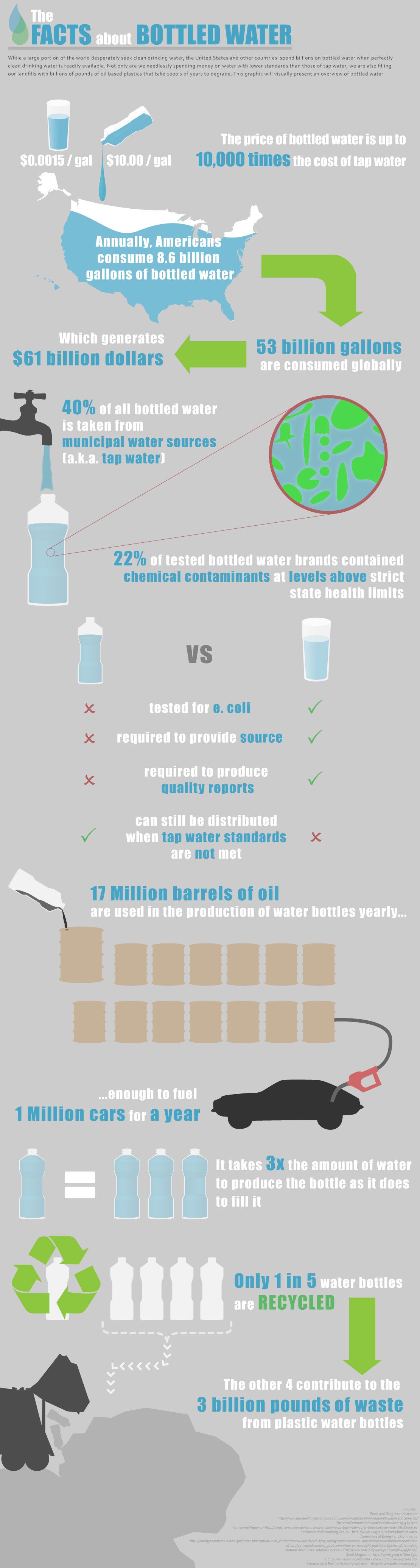
bottled water infographic 274x1024 All About Drinking Water

References

Brorstrom-Lunden E, et al. Measurements of sucralose in the Swedish Screening Program 2007. Swedish Environmental Research Institute.  Last accessed: 12/26/08.
Clark WF, et al. Excessive fluid intake as a novel cause of proteinuria. CMAJ 2008;178:173-175.
Consumer Reports. Water filters. Last accessed: 12/26/08.
EPA Drinking water and health. What you need to know. Office of water. October 1999.
Drinking Water: The District of Columbia and communities nationwide face serious challenges in their efforts to safeguard water supplies. Highlights of GAO-08-687T, a testimony before the Subcommittee on Federal Workforce, Postal Service, and the District of Columbia, Committee on Oversight and Government Reform, U.S. House of Representatives.
FLOW: For The Love Of Water. DVD Film. 2008. Irena Salina.
For the good of our water supply, kick the bottle. ENR 2007;259:104.
Ingram C. The Drinking Water Book. 2nd Edition. Celestial Arts. 2006.
Jarup L. Hazards of heavy metal contamination. Br Med Bull 2003;68:167-182.
Krishnan K & Carrier R. Approaches for evaluating the relevance of multiroute exposures in establishing guideline values for drinking water contaminants. J Environ Sci Health C Environ Carcinog Ecotoxicol Rev 2008;26:300-316.
Mahan LK, Escott-Stump S. Krause’s Food, Nutrition, & Diet Therapy. 11th Edition. 2004.
Men’s Health Best Life – December 2008 – Tips On Shrinking Water Footprint.
Royte E. Bottlemania: How water went on sale and why we bought it. Bloomsbury. 2008.
Snitow A. Thirst Response. Men’s Health Best Life. December 2008/January 2009. Page 78.
Stein RJ. Water Supply. The Reference Shelf. H.W. Wilson Company. 2008.
Yermiyahu U, et al. Rethinking desalinated water quality and agriculture. Science 2007;318:920-921.


Friday, May 11, 2012

The Fat Loss Fallacy


For many years, aerobic training was considered the staple of any exercise program, especially if fat loss was the goal. We were told that if we move at a moderate pace for extended periods of time, we would find ourselves in the “fat burning zone”. We were also told that all this training would help us to live longer, healthier lives because of the cardiovascular benefits. Unfortunately, the idea that slow, steady pace exercise is the golden ticket for fat loss or cardiovascular health is somewhat misleading.

When most people talk about aerobic training, they are usually referring either to running or some sort of group class, but it can really mean any activity that you sustain for long periods of time (technically 3+ minutes, but it can last for hours once it kicks in). Aerobic just means that you are using oxygen to maintain your activity, which differs from those energy systems used to help you sprint, lift weights, or climb a hill on your bike. While running, biking, swimming, etc. at moderate pace for long periods of time can have small benefits, they are inefficient at best. This is especially true for fat loss.

Let's Look at the Research

The problem is that there has never really been any data to back up the fat loss benefits of aerobic training. In a study looking at two groups of obese women, the researchers found that adding 45 minutes of aerobic training 5 days a week for 12 weeks had NO EFFECT over dieting alone. That is 4.5 hours a week of running that did nothing! 

http://www.ncbi.nlm.nih.gov/pubmed/9738131

In a study looking at a six month period where the participants were running for 50 minutes, 5 times per week, the results came out poorly. After over 100 hours of exercise, there was no additional effect on weight or body fat levels. I would not be happy if I put that much time into something that resulting is such little progress. 

http://www.ncbi.nlm.nih.gov/pubmed/17200169


How Did this Happen?

Why were people so sure that this is the way fat loss occurs? 

It all comes back to the misunderstanding of the “fat burning zone”. This zone represents the intensity level at which your body is using fat as its main source of energy. Your body happens to utilize fat more at lower intensities and utilizes carbs more at higher intensities. So it was logically thought that if you are burning a high percentage from fat, then you will be able to burn more fat calories overall! There are two flaws in this argument. First, by this logic, sitting on your couch would actually burn the most fat because you are at rest! The problem is that you are not burning very many calories total, so the percentage doesn’t matter. The second, and more important factor, is that this only takes into account what happens during the workout. There is no recognition of the recovery period after exercise. If you were to only look at what happens in the body during a workout you would notice similar amounts of total fat burned (not % of fat burned) for a given amount of exercise, regardless of intensity. The missing factor in all of this is what happens in the 48 hours after you leave the gym. 

Your body is always looking to restore equilibrium, and the further your push it away from your resting state, the harder it has to work to get back. So when you have a long slow training session, you may burn some calories during the workout, but your body doesn’t have to work very hard to restore itself afterward. The more intense the workout, the more work your body has to do to recover. 

In a study comparing a 20-week endurance training program with a 15-week high intensity interval training program, the researchers found that the endurance group burned over 28000 calories while the interval group only burned around 13500 calories. Despite burning only half the calories, the interval training group actually showed a NINE TIMES greater reduction in subcutaneous fat (this is important because this is the fat that lies under the skin and can give the dimpled cellulite look). 

http://www.ncbi.nlm.nih.gov/pubmed/8028502

The Fat Burning PLAN

The truth is, exercise is not about what happens at the gym, but it is what your body does in response to that exercise during the recovery period. This is why high intensity training like weight lifting and intervals work the best; they force your body to recover. This doesn’t mean you need to go to the gym and kill yourself right away, just start building up your intensity over time. If you can only workout 2-3 times per week, weight training is always better due to the large requirements it places on your muscles. Interval training is a good supplement to weight training but should not replace it.

One final note: long, slow activity can be great for recovery. While it does not do much on its own, staying active can make a big difference in how well you respond to your more intense exercise. If you weight train and then sit for the next 48 hours, your body will not recover nearly as well (aka not burn as much fat) than if you stayed active. Walking, stretching, foam rolling, hiking, gardening, light swimming and biking; these are all good activities for helping you to recover from your more intense bouts of exercise and should be done daily if possible.

So there you have it. Strength training, plus interval training, plus daily movement is the way to go for burning fat. If this is your goal, maybe it’s time to evaluate your current exercise program and see if what you do aligns with what you want to achieve. 


Friday, May 4, 2012

The Fat Loss Fuel


Over the years, many diet trends have come and gone. First it was the low fat, then the low carb, then the balanced meals, then the whole foods. Each generation has come up with a new hot diet, but why do these never seem to last? The problem is that to sell a diet, you have to make it different. You have to make it special in some way, unique, and this ends up hurting long-term sustainability. The truth is that there is nothing special or unique about eating “healthily”, it’s actually quite boring, and it’s all things that most of us already know we should do. Don’t eat too much, stay away from junk/processed foods, drink water, eat your veggies, etc. If we all started doing these things today, we would be healthier in no time.

One dietary idea, however, has only recently been getting more attention and I want to help propel this as just one more standard ingredient to staying healthy. If you want to be lean, get in your protein. Protein has always been on the back burner of the diet debate and has even gotten a bad rap for potential health concerns. Today, let’s look at why protein is a vital part of looking and feeling your best. 

What are proteins and why are they important?

Proteins are molecules made up of amino acids—the building blocks of life. These amino acids are joined together in specific ways that are necessary for our bodies to function properly. During digestion, protein is broken down into these building blocks so that the body can later reconstruct them into other molecules such as enzymes, hormones, neurotransmitters, and antibodies. If you do not eat enough protein, your body will be unable to manufacture these molecules and will stop working as well.

There are two main categories of amino acids in the body. First, there are essential amino acids – those that the body can’t manufacture and must be consumed in our diets. Second, there are nonessential amino acids – those that the body can usually make for itself. Eating enough protein to fully supply your amino acid needs is essential when it comes to optimal health. In addition to creating the molecules listed above, it also helps to replace worn out cells, transports various substances throughout the body, and aids in growth and repair.

Getting to the point

Yeah, yeah, protein is important, but what does that have to do with losing weight and burning fat?? Okay, so now that you know why protein is fundamentally important to your functioning, let’s look at how eating more protein can actually help you to look your best. When it comes to protein and fat loss, there are three main ways that it can help.

1) Satiety. Protein keeps you fuller longer, leading to a decrease in calories consumed. If you have protein at every meal, you will not eat as much per meal and you will not need to eat as often.

2) Hormones. Protein consumption results in the release of a hormone called glucagon. Glucagon is your best friend when it comes to fighting fat because it signals your cells to release fat to be used as fuel. There is no more direct way to make your body start burning fat than to eat some protein!

3) Fats. Something that we often talk about on this blog is the importance of eating high-quality meats. Grass-fed, wild, and pastured are always preferred because when you eat these sources of protein, you also ingest high quality fats. These fats help to balance out our diets and can actually have their own positive effect on fat loss.

How much protein do you need?

The amount of protein you need is based primarily on your level of activity. The minimum amount that anyone should eat is 0.4 grams per pound. So for a 150 lb. individual, you would need a minimum of 60 grams per day. But this would really just be the amount needed to survive. Yes, we need protein for the basic function of preventing deficiency, but for optimal functioning and fat burning, we really need 2-3x this much.

A good standard to go by is that if you are active (exercising consistently), you probably need 1 gram per pound of body weight. If you never exercise, you could probably get away with 0.8 g per pound, but to be honest, if you never exercise, protein consumption is not your biggest concern.  

Now that we know how much protein to eat, let’s talk about when to eat it. First, it is always best to spread out your protein over the course of the day. While your body can use a decent amount eaten in one sitting, you will store and utilize more of it if you eat some at each meal. You can actually increase how effective you are at utilizing your protein by exercising, specifically by weight training. If you do participate in weight training, it would also be best to have some protein before and after your session to maximize your recovery. When you train with weights, you are actually breaking down muscle so that your body will adapt and build more muscle. You can only do this, however, if there is adequate protein in your system, meaning that the more consistent you are with protein intake, the better off you will be.
Protein Reflection

Most people do not really think about how much protein they eat, let alone how much they eat in general. This is why I have a three-step system for evaluating your protein intake. Only advance to the next level when you feel confident with the one before it.

1) If you have no idea about how much protein you eat, start by just becoming aware of your meals. Does each one have some portion of protein? And when I say protein, I mean animal protein. Beef, chicken, lamb, salmon, shrimp, eggs, etc. These types of protein will always be superior to any alternative, so unless you are vegetarian, go for the meat! If you are a vegetarian, you will have to be a little more creative, but the best way to go is either a protein powder, tofu/tempeh, or beans. While these are not optimal, it is important to get your protein in as best you can.

2) If you go through this first exercise and determine that you are already including a protein source at each meal, the next thing I would do is reflect on the quality. There is a big difference between bacon and pastured pork chops. Any time you can trade out processed or conventionally raised meats, do so.

3) The last thing, for those of you that are all about your protein, it can be a good idea to weigh and track how much protein you actually get in a day. If you just do this for a few days, you will have an image of what 4 oz, 6 oz, and 8 oz of meat look like, and how much protein each of those provide. You can use www.myfitnesspal.com to find out how much protein you are actually consuming.

Wherever you land on this spectrum, I do highly encourage that you find ways to add high-quality proteins into your diet. There are too many benefits to doing something that is so simple. 


Friday, April 27, 2012

Food Quality: It’s Scary Stuff

Just last year, 128,000 Americans were hospitalized due to foodborne illnesses. 3,000 of these people did not survive. It starts to make you wonder…what the heck is going on with our food?! With ever growing demands for affordable food products, our country has turned to big agriculture and feed lots to provide large quantities of low cost “food”. The problem is that when you treat your food poorly, it returns the favor.

In order to produce such large quantities at affordable rates, large food producers have to find ways to cut corners, increase productivity, and drive down costs of production. While this makes the price tag go down at the supermarket, it ends up also increasing the cost on your health. Pesticides, antibiotics, growth hormones, genetic modifications, poor conditions, poor top soil, poor animal feed, and dumping of waist/ toxins are just some of the tactics used by these companies to lower costs and increase production. All of this ends up affecting the food that you eat, and in turn, your health.

If you want to learn more about these issues, please do yourself a favor and go rent Food Inc., a documentary on just how bad the food industry had become when it comes to its concern for your wellbeing. There is more info in there than I can cover in this post, but just know that it takes on just about every angle of how this system of food production is hurting us.

What I want to focus on, rather, is what you can do to remove yourself from the cycle. If you are looking to really change the way you look and feel, food quality is a great place to start. The following are the best principles to follow to ensure the highest quality possible:

1) Buy from your local farmers. Go to the farmer’s market, talk with the people growing your food, and find out what they are doing to ensure its quality. If this is not possible, at least find out from your local grocer when new shipments come in so that you can buy fresh and still look for local products.

2) Buy often. Once you find a good place to purchase your food, try to shop for only 2-3 days at a time. If you need something to last longer than this, keep it in the freezer.

3) Buy organic. This is where talking with your local farmer can make a big difference, because you can really get to the bottom of what they mean when they say organic. Large companies do not always have as strict of procedures to ensure “organic” status, so talk with your food provider about how they ensure that no toxins are used in producing your food.

4) Wash your plants. Before you prepare your meals, be sure to wash your plants. This becomes infinitely more important if you were unable to buy organic, but even if you were, it’s always a good idea.

5) Don’t forget to look at what you eat eats. Grass fed/wild animal products will always be superior.

6) Look at the label. If you want the highest quality foods, they probably won’t have a label, but if you are unsure, take a look at the back and see what the ingredients are. If there are more than 3 ingredients, and any of them are unknown or hard to pronounce, you may want to reconsider the purchase.

These are just a few ways to ensure that you are eating the highest quality food possible, and keeping yourself from becoming a statistic.  While the amount of food we consume is always important, we must respect the quality of our food if we hope to look and feel our best. Losing fat (not just weight), optimizing energy, preventing disease, and even improving and stabilizing mood can all be linked back to the quality of our food. Our bodies were not meant to consume chemicals, toxins, and decayed food, so it is up to us to search out the best food options if we are to live long, fulfilling lives.

If you would like more information on food quality, please check out Food Inc.:


Also, if you would like to find a farmer’s market near you, here is a list of all those markets in Santa Clara County:


Thursday, April 19, 2012

Your Most Valuable Asset

“Action expresses priorities…” – Mahatma Gandhi

What a wonderful quote. This one idea summarizes all the advice anyone needs for being successful. Action is something that we talk about frequently on this page, but in the end it all comes down to this idea of priorities. We can all say that we want to be healthy, or lose weight, or change the way we eat, but in the end, if it is not a priority, it will not happen.

What I think we can learn from this idea is that before setting off to accomplish any goal, we must first take a good hard look at what our priorities are, and how we express those through our actions. One very effective way to do this is to keep an activity log dictating what you spend your time doing. You can do this for just one day, or even better, 3-5 days. Once you have this, it makes it much easier to see what your priorities really are. If you say that exercise is important, but spend more time watching TV than in the gym, maybe fitness is not so important after all. If you say eating well is important, but you eat out 5 days a week, again, maybe you need to reflect on if this is really a priority at this moment.

This is not to say that any of these things HAVE to be your priority, but it is important to at least acknowledge where your priorities lie so that you can chose your next move. If you realize that you do spend more time watching TV than at the gym, then you have a choice. You can either decide that you would rather enjoy your favorite shows than reach your fitness goal, or, you put in the effort with your training and limit the time on the couch. There is no right answer, but this is something that each one of us must face if we hope to be successful in our lives and our goals.

If you have been trying to make a change, but are struggling to do so, perhaps this will be a good way to kick start your efforts. Start by establishing what your goals are (health related or otherwise). Then determine which areas of your life you need to prioritize. This could be exercise, sleep, reading, networking, saving, cooking, spending time with family, etc. Then list these in order from most important to least. Now that you have this, all you need is your activity log.

Spend the next few days jotting down everything you do, and how much time you spend on it. The more specific the better—if you spent 10 minutes on Facebook scanning your news feed, it goes on the log! Once you have this written out, take note of how much time you actually spent on your top priorities. Look at how much time you spent elsewhere. It can be truly amazing how much time and energy we devote to activities that are in no way conducive to our goals or our priorities, yet we let these activities rob us of our time every day! The good news: now that you have this in front of you, you can make the changes necessary to align your time with those things that are most important with you.

Do your actions express your priorities?